| 1-Vehicles / Allies / France / 1-Tanks / Files / St-Chamond.htm | Last Up-date: 01-12-2019 | ||||||||||||||||||||||||||||||||
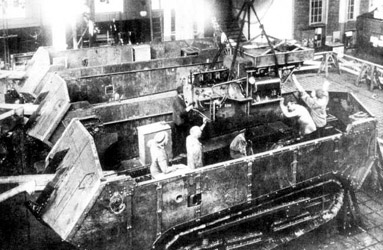
St. Chamond Genesis Le char Saint-Chamond M-16, une idée du colonel Rimailho pour le compte de la STA (Service Technique Automobile), présentait de nets avantages par rapport au Schneider. Il était plus long, plus puissant (un canon de campagne de 75 mm et 4 mitrailleuses), mieux protégé. Son équipage était composé de 8 hommes. L'armée française commanda 400 exemplaires de ce char. Le premier prototype fut finalisé par F.A.M.H. de Saint Chamond (près de Lyon) au début 1916. The
tank Saint-Chamond M-16, an idea of colonel Rimailho on behalf of
the STA (Service Technique Automobile/Automobile Engineering service),
presented obvious advantages compared to Schneider. It was longer,
more powerful (a field gun of 75 mm and 4 machine-guns), protected
better. Its crew was composed of 8 men. French Army ordered 400 specimens
of this tank. The first prototype was finalized by F.A.M.H. of Saint
Chamond (close to Lyon) at the beginning of 1916.
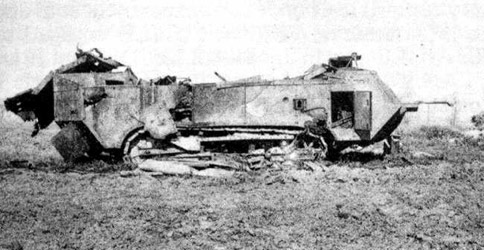
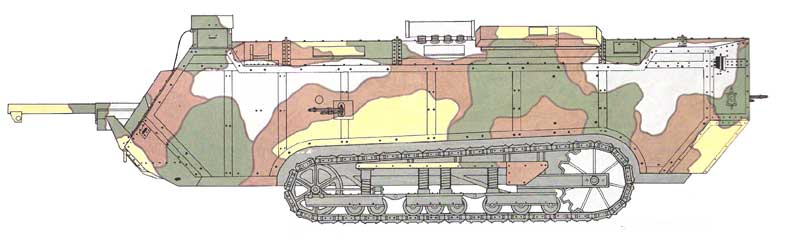
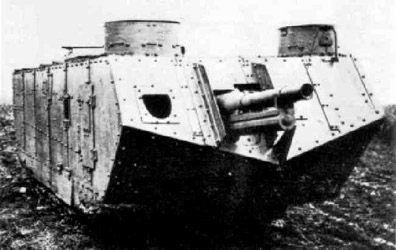
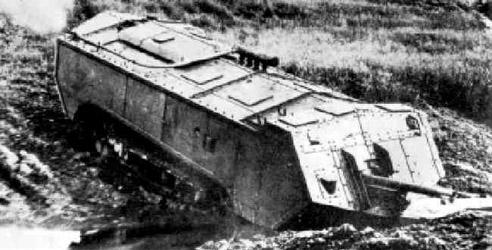
Design Le char Saint-Chamond était comme le Schneider un caisson blindé mais plus allongé ici. Ce caisson faisait saillie à l'avant et à l'arrière du char. Le moteur 4 cylindres essence Panhard, actionnait une dynamo qui procurait à deux moteurs électriques l'énergie nécessaire. Ces derniers faisaient fonctionner à leur tour les barbotins du train de roulement basé sur celui du tracteur Holt américain. Le train de roulement comprenait 3 paires de boggies suspendus par des ressorts en volute. Chaque chenille comprenait 36 patins. Les premiers engagements montrèrent que les chenilles étaient trop étroites et que le char piquait du nez à l'avant en raison d'une partie frontale trop lourde et trop basse. La partie avant fut donc rehaussée (cette action améliora les possibilités d'observation) et un toit en pente remplaça le toit plat initial (muni de kiosques d'observation). Le toit en pente avait pour but de faire rouler les grenades allemandes. Les premiers modèles dépourvus de kiosque offraient une visibilité très médiocre au pilote qui en plus avec ses volets rabattables avait aucune protection lorsque ces derniers étaient en position ouverte. Par la suite, un kiosque a été aménagé pour le pilote. Le canon d'origine (un 75 mm Saint-Chamond) fut remplacé également par un 75 mm modèle 1897. L'arme tirait des obus de shrapnels de 7.2 kg à 539 m/s à plus de 6850 m. Un bon équipage pouvait tirer à une cadence de 30 obus/minute. L'armement était complété par quatre mitrailleuses Hotchkiss de 8 mm. La caisse du Saint-Chamond était constituée plaques métalliques rivetées de 17 mm d'épaisseur maximum. The Saint-Chamond tank was like Schneider an armored box but more lengthened here. This box made covered in front and at the back of the tank. The four-cylinder Panhard gasoline engine, actuated a dynamo which got for two electrical engines the energy necessary. The latter made function in their turn the sprocket-wheels of the running-gear based on that of American Holt tractor. The running-gear included 3 pairs of bogie suspended by springs in volute. Each track included 36 links. The first engagements showed that the tracks were too narrow and that the tank went into a nose dive in front because a too heavy and too low frontal part. The front part was thus raised (this action improved the ' possibilities of observation) and a pitched roof replaced the initial flat roof (provided with kiosks of observation). The purpose of the pitched roof was to make roll the German grenades. The first models deprived of kiosk offered a very poor visibility to the driver who in more with his folding shutters had any protection when the latter were in open position. Thereafter, a kiosk was arranged for the driver. The gun of origin (one 75 mm Saint-Chamond) was also replaced by one 75 mm model 1897. The weapon fired shrapnels rounds of 7.2 kg to 539 m/s with more than 6850 m.. A good crew could fire at a rate of 30 rounds/minute. The armament was supplemented by four Hotchkiss machine-guns of 8 Mmm. The hull of Saint-Chamond was made up riveted metal plates of maximum 17 mm of thickness.
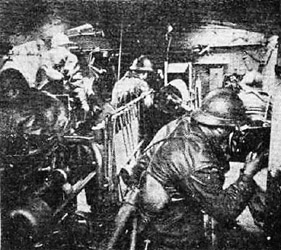
Le porte-à-faux très important de la caisse du Saint-Chamond faisait de ce véhicule un engin très difficile à conduire sur terrain accidenté. Le manque de stabilité pouvait en outre procurer à l'équipage le mal de mer. Le Saint-Chamond avait été aussi conçu pour franchir les tranchées allemandes, et ce fut un échec partiel. Autre défaut du Saint-Chamond, le manque de ventilation qui pouvait faire monter la température à l'intérieur à plus de 40° C. L'intéressante motorisation essence-électrique pouvait propulser le Saint-Chamond à 8 km/h sur route mais la faible capacité des réservoirs ne permettait qu'une autonomie de 60 km. The very important overhang of the case of Saint-Chamond made of this vehicle a machine very difficult to drive on rough ground. The lack of stability could moreover get for the crew the sea sickness. Saint-Chamond had been also designed to cross the German trenches, and it was a partial failure. Another defect of Saint-Chamond, lack of ventilation which could raise the temperature to the interior at more 40° C. The interesting gasoline-electric motorization could propel Saint-Chamond to 8 km/h on road but the low capacity of the tanks did not allow that a range of 60 km.
St. Chamond in Action Entre février 1917 et février 1918, 12 unités de chars Saint-Chamond furent constitués au camp de Champlieu. Chaque unité comprenait 4 chars. Les chars Saint-Chamond furent utilisés au combat pour la première fois le 5 mai 1917 durant l'assaut du plateau de Laffaux. Sur les 16 Saint-Chamond mis en ligne, tous sauf un s'embourbèrent sur les premières lignes des tranchées allemandes, ce qui fut fréquent par la suite. Certains furent modifiés en transport de troupes sans le canon de 75 mm. Les chars Saint-Chamond équipèrent également les unités du Corps Expéditionnaire Américain en France, aussi équipés de chars Schneider. Between February 1917 and February 1918,12 units of Saint-Chamond tanks were made up at the camp of Champlieu. Each unit included 4 tanks. The Saint-Chamond tanks were used in the combat for the first time on May 5, 1917 lasting attack of the plate of Laffaux. On 16 Saint-Chamond put in line, all except one were stopped by mud on the first lines of the German trenches, which was frequent thereafter. Some were modified in transport of troops without the gun of 75 mm. The Saint-Chamond tanks also equipped the units of the American Task force in France, also equipped with Schneider tanks.
|
||||||||||||||||||||||||||||||||
/Bt-off.jpg)
/Bt-off.jpg)